

Image credits: EDGE Technologies
Designing for Human Wellbeing
In 2018, I joined EDGE Technologies at a pivotal moment in the company’s evolution. Having established itself as one of Europe’s leading innovators in sustainable real estate, the next question became increasingly important: if buildings could dramatically reduce their environmental footprint, could they also improve the lives of the people inside them?
That question became the focus of my work over the following seven and a half years.
With a background spanning psychology, sustainability and the built environment, I helped shape EDGE’s approach to wellbeing. Not as an additional feature, but as a design principle embedded throughout the development process. Working alongside architects, engineers and workplace specialists, I translated emerging research into practical design strategies that could be applied consistently across projects in the Netherlands, Germany and the United Kingdom.
Rather than designing individual spaces alone, much of my work focused on creating the frameworks behind them: developing technical design briefs, translating scientific research into actionable guidelines, and building a shared language around health, comfort and human experience. The goal was simple: ensure every project reflected the same ambition, regardless of its scale or location.
One of the earliest milestones was contributing to the wellbeing strategy for EDGE Olympic in Amsterdam; one of Europe’s earliest WELL Platinum certified office buildings and a workplace that continues to rank among the world’s highest-performing offices through independent workplace experience research. Projects that followed, including EDGE Amsterdam West and EDGE Stadium, allowed us to continue refining this approach. Each development became an opportunity to test new ideas, measure their impact and translate those lessons into practical design principles for future projects.

Edge Amsterdam West. Image credits: Edge Technologies
Measuring What We Could (not) See
One of the questions that fascinated me most was surprisingly simple: if we design buildings to improve wellbeing, can we actually measure whether they work?
Together with researchers from University College London and the technology start-up LYS, we explored that question through a large-scale workplace study. Participants wore wearable light sensors throughout the day, allowing us to compare their individual daylight exposure with sensor data from the building itself and traditional workplace surveys.
The results were remarkable. Employees working in EDGE Olympic received up to 2.1 times more biologically effective daylight than participants working in a conventional office environment. Rather than actively seeking daylight throughout the day, they benefited from it simply by working in a building intentionally designed around natural light.
Interestingly, participants in the comparison building began changing their own behaviour once they received their personal reports. Some chose to leave the metro one stop earlier, walking the final stretch to the office to increase their morning daylight exposure and better support their circadian rhythm.
For me, that became one of the clearest demonstrations of architecture’s quiet influence. Well-designed environments reduce the cognitive effort required to make healthy choices. Rather than relying on constant self-discipline, the building itself becomes part of the solution.

LYS Technologies wearable button and app
Translating Neuroscience into Space
Another project took this question a step further. Rather than asking how buildings affect physical wellbeing, we began exploring how architecture might influence concentration, creativity and cognitive performance.
Around that time, I became fascinated by ideas emerging from neuroscience and cognitive psychology, particularly around how our surroundings influence attention. One concept that stayed with me was The Eudaimonia Machine, an architectural proposal by David Dewane that was later introduced to a wider audience through Cal Newport’s work on Deep Work. Rather than seeing a workplace as a collection of rooms, it imagined a sequence of spaces that gradually guide people from social interaction towards increasingly deeper states of focus.
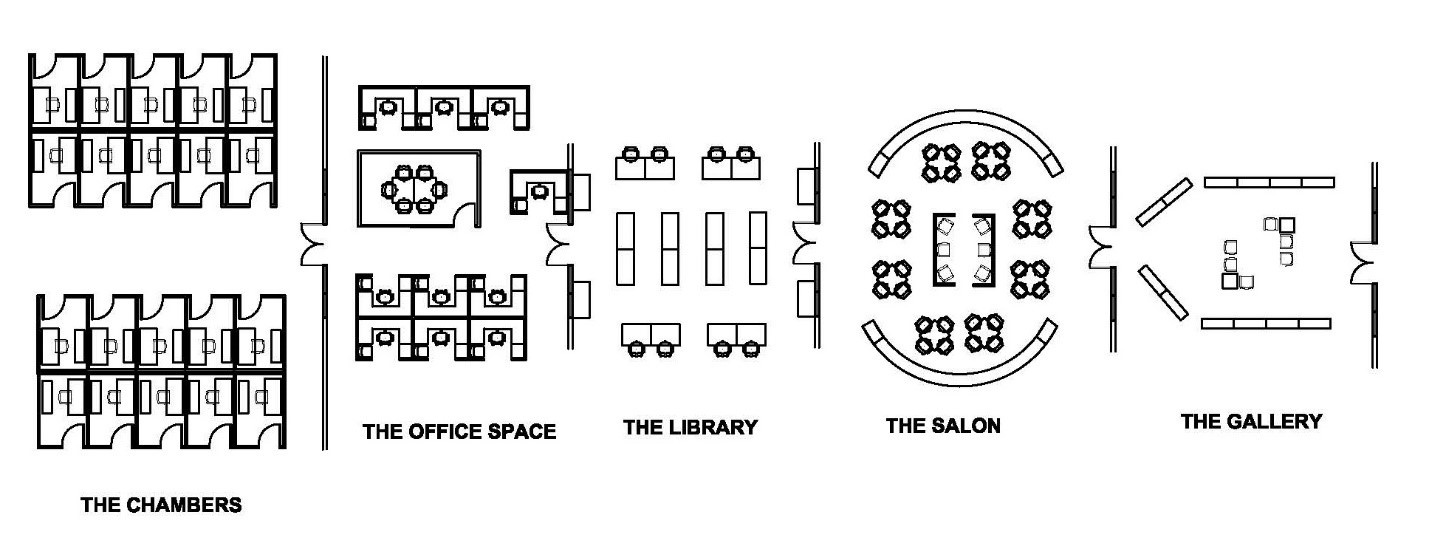
Image: Eudamonia concept by David Dewane
Inspired by this philosophy, we explored how a workplace in Berlin could support different cognitive needs without increasing its footprint. Working alongside neuroscience specialists, and the project team, we collaboratively developed a spatial strategy that balanced collaboration, informal interaction, focused work and quiet retreat. Instead of treating every employee the same, we asked a different question: how might the workplace better support different ways of thinking, working and restoring attention throughout the day?

Implementing the concept at EDGE Grand Central Berlin. Image credits: Edge Technologies
At the time, these conversations were still relatively new within commercial real estate. Looking back, it’s fascinating to see how many of these early explorations have since evolved into what we now recognise as neuroinclusive design and neuroarchitecture. What felt experimental then has become an increasingly important part of the conversation around workplace design.
Sharing the Conversation
Alongside project work, I increasingly shared these ideas with the wider industry through international conferences, publications and interviews. Speaking at events including The Next Web, WorkTech, the WELL Conference in Washington and Workplace Design Show gave me the opportunity to translate complex research into practical conversations with architects, developers and workplace professionals.
Those conversations reinforced something I had begun to realise throughout my work: wellbeing isn’t created through individual features or certifications alone. It emerges from the relationship between people, space and experience.

Speaking at The Next Web 2023 with Sonya Simmonds - Head of Workplace at Spotify, and Joshua Morris - Global Capital Markets at Knight Frank, moderated by Malcolm Moore - Financial Times![]()
![]()
Beyond the Building
Towards the end of my time at EDGE, my attention gradually expanded beyond the building itself.
If architecture can influence the wellbeing of the people who work inside it, what responsibility does it have towards the city and community around it?
That question led to collaborations exploring how office buildings could become more open, shared and socially connected. Working with the social enterprise Use/Space, we began opening underused spaces to charities, neighbourhood initiatives and cultural organisations outside office hours.
One of my favourite examples emerged almost unexpectedly. The atrium of EDGE Stadium proved to have exceptional acoustics, leading several Dutch orchestras to rehearse there on a regular basis. On one specific evening, local residents were invited to attend a rehearsal by Symphony Orchestra De Philharmonie; transforming what would otherwise have remained a private office building into a place of culture and encounter.
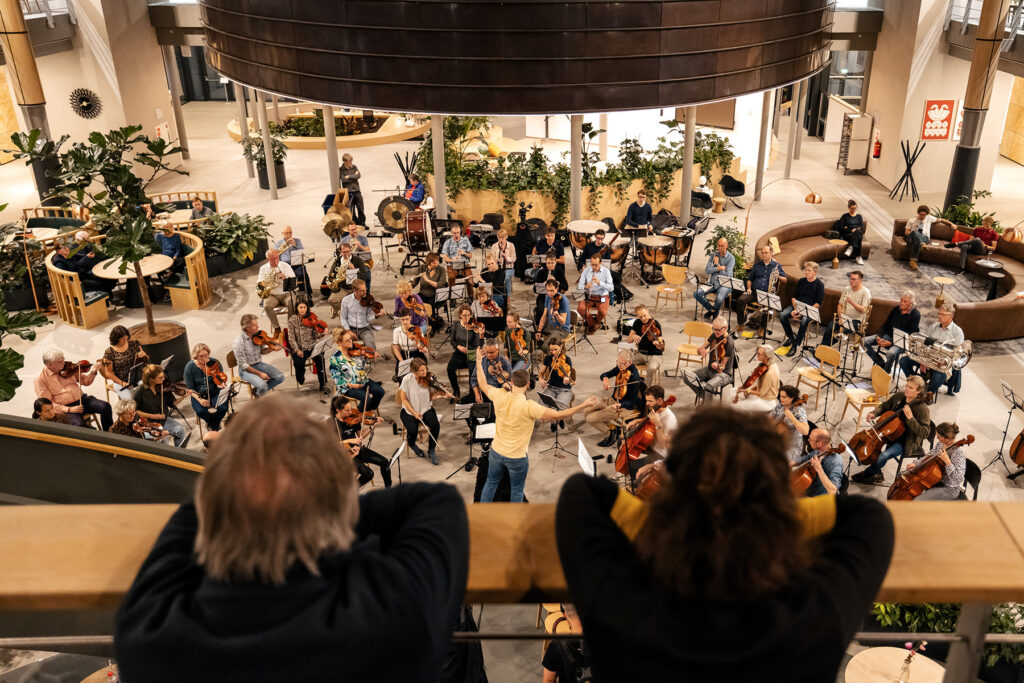 Image credits: D/DOCK
Looking back, it felt like a natural progression. My work had begun with individual wellbeing, expanded into organisational health, and gradually evolved towards thinking about the social role buildings can play within the wider city.
During those seven and a half years, my understanding of wellbeing changed profoundly. It was no longer simply about healthier offices or better certifications. It became about designing environments that quietly support people—in how they focus, connect, move, recover and ultimately belong.
That belief continues to shape every project I work on today.